
Blooming
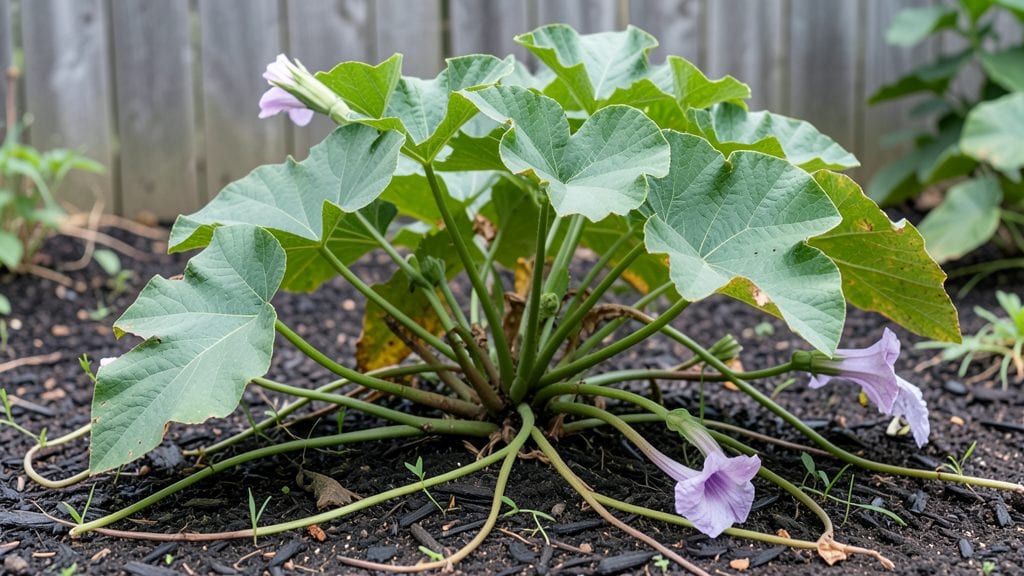
Sweet potato plants do bloom under ideal conditions, producing small yellow or orange flowers that resemble morning glories. These blooms appear in late summer or early fall, signaling tuber development below ground.
Those delicate flowers aren't just pretty—they're a clear sign your sweet potatoes are thriving. 🌸 The blooming process kicks in after the vines mature, typically when daytime temperatures hover between 75°F and 85°F with cooler nights.
This timing coincides with tuber formation, so seeing flowers means your harvest window is approaching. What's fascinating is how these plants balance above-ground blooms with below-ground growth, almost like nature's perfect multitasking act.
For gardeners eager to see those cheerful blossoms, focus on well-draining soil with a slightly acidic pH (5.8 to 6.5). Overwatering or excessive nitrogen can delay flowering, so aim for 1-2 inches of water per week and use balanced fertilizer.
The key is patience—some varieties take 90-120 days from planting to bloom, but the wait pays off with both beauty and bounty.
💡 In This Article
- Sweet Potato Flowering Stages and Growth Conditions
- Encouraging Sweet Potato Flowers for Better Yields
Sweet potato flowering stages and growth conditions
Here's what's actually happening when those vibrant blooms appear: sweet potato plants follow a precise botanical timeline where vine growth and flowering are tightly linked. The process begins with the plant's vegetative stage, where it focuses on leaf and vine production to build energy reserves through photosynthesis.
Once the vines reach about 3-4 feet long and the plant has established a strong root system, it enters the reproductive phase—triggered by day-length changes (photoperiodism) and temperature cues.
This transition typically occurs when days shorten in late summer, signaling the plant it's time to shift resources toward both flowering and tuber development.
The flowers themselves emerge from leaf axils on trailing vines, unfurling in the morning and wilting by afternoon—a daily cycle that continues for 2-3 weeks per bloom.
Each flower is about 1-2 inches wide with five delicate petals, and while they're not edible, their presence is a clear indicator that the plant is directing energy below ground.
What most people don't realize is that the flowering process actually accelerates tuber growth—the plant's hormonal shift from vine production to reproduction stimulates the development of storage roots. This is why you'll often see the most robust tubers forming right after the peak bloom period.
Temperature plays a critical role in this process, with optimal conditions ranging from 75°F to 85°F during the day and 60°F to 65°F at night.
Humidity should stay between 40% and 60%—too much moisture can lead to fungal issues that stunt flowering, while dry conditions may cause buds to drop before opening. The plant needs full sun exposure (6-8 hours daily) to maintain the energy balance between above-ground blooms and below-ground tubers.
Without sufficient light, the plant will prioritize vine growth over reproduction, delaying or preventing flowering entirely.
What makes this particularly interesting is the plant's dual strategy: while the flowers attract pollinators (though sweet potatoes are typically grown for their tubers, not seeds), the real goal is tuber development.
The flowering stage represents about 20-30% of the plant's total growth cycle, with the remaining time focused on establishing roots and storing nutrients.
Some varieties, like 'Beauregard' or 'Georgia Jet', are particularly prolific bloomers, producing 50-100 flowers per plant during their peak season, while others may be more subdued in their floral displays.
Here's a key comparison: flowering typically begins when tubers are already 1-2 inches in diameter, but the most rapid tuber growth occurs 2-4 weeks after the first blooms appear.
This timing window is crucial for gardeners—if you see flowers in early August, you can expect harvest-ready tubers by late October or early November, depending on your climate zone. The plant's ability to coordinate these processes demonstrates nature's efficiency in resource allocation.
One fascinating detail is how the flowers' color varies by variety: 'Porto Rico' produces deep orange blooms, while 'Bonita' features pale yellow flowers. These colors aren't just decorative—they're part of the plant's pollination strategy, designed to attract specific insects that help with cross-pollination.
However, since sweet potatoes are primarily grown for their edible tubers rather than seeds, this pollination aspect is often overlooked in cultivation practices.