Fertilization
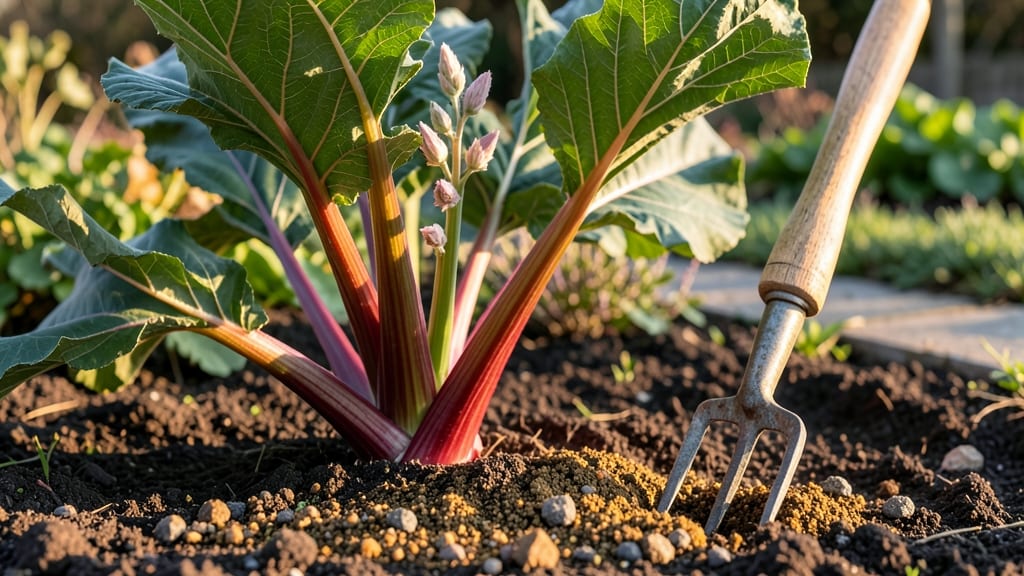
Fertilizing rhubarb plants the right way turns your bland stalks into garden gold 🌱—and it starts with knowing exactly when, what, and how much to feed them.
Picture this: you’ve spent all spring watching your rhubarb leaves flourish, only to harvest tart, fibrous stalks that taste more like disappointment than dessert. The fix isn’t more water or sunshine—it’s a fertilizer strategy tailored to rhubarb’s quirks, from soil pH to timing.
Skip the guesswork, and I’ll show you how to balance nutrients so your plants focus on sweet, tender growth.
Rhubarb thrives on a light, consistent feed—not the heavy-handed approach that works for tomatoes or peppers. We’re talking organic compost in early spring, a balanced NPK boost after harvest, and zero fertilizer once fall rolls around.
Overdo it, and you’ll end up with lush leaves but woolly stalks that ruin pies. Get it right, and you’ll harvest plump, vibrant stalks for years.
Below, I break down the exact fertilizers to use (organic vs. synthetic), the timing that matters most, and how to spot when your rhubarb is begging for a break—not more food. Ready to turn your patch from forgettable to fantastic?
Optimal soil pH and nutrient requirements for rhubarb growth
Rhubarb thrives when your soil’s pH level sits between 6.0 and 6.8. This slightly acidic to neutral range ensures your plants absorb essential nutrients efficiently, leading to sweeter stalks and fewer woolly, fibrous textures.
If your soil tests outside this range, simple amendments like lime for acidity or sulfur for alkalinity can make all the difference.
Beyond pH, rhubarb demands a balanced nutrient profile to prevent common issues like leafy dominance or poor stalk development. The three primary nutrients—nitrogen (N), phosphorus (P), and potassium (K)—must be in harmony.
Too much nitrogen? You’ll get lush leaves but bland stalks. Too little phosphorus? Your rhubarb may struggle to establish strong roots, leading to weak growth.
Don’t overlook micronutrients like calcium and magnesium, either. Calcium prevents stalk woolliness, while magnesium supports chlorophyll production for vibrant, healthy foliage. A deficiency in either can turn your prized harvest into a fibrous mess—so soil testing is your first step to success.
Here’s how to check and adjust your soil’s fertility before planting:
1. Conduct a soil test using a home kit or send a sample to your local cooperative extension service for precise results. 2. If your soil is too acidic (below 6.0), mix in pelletized lime (follow package rates for your soil type).
3. For alkaline soil (above 6.8), incorporate elemental sulfur or peat moss to lower the pH gradually.
Once your pH is ideal, focus on organic matter. Rhubarb loves well-draining, fertile soil rich in compost or aged manure. Aim for at least 2-3 inches of compost mixed into the top 12 inches of soil before planting.
This boosts nutrient retention and improves water absorption, reducing the risk of root rot.
Now, let’s dive into the nutrient breakdown your rhubarb craves:
| Nutrient | Role in Growth | Signs of Deficiency | Amendment Source |
|---|---|---|---|
| Nitrogen (N) | Leaf and stalk growth | Yellowing leaves, weak stalks | Blood meal, compost, synthetic 10-10-10 |
| Phosphorus (P) | Root development, flowering | Purple stems, slow growth | Bone meal, rock phosphate |
| Potassium (K) | Stalk sweetness, disease resistance | Brown leaf edges, weak stalks | Wood ash, greensand, synthetic 10-10-10 |
| Calcium (Ca) | Prevents woolly stalks | Fibrous, tough stalks | Crushed eggshells, lime |
| Magnesium (Mg) | Chlorophyll production | Yellowing between veins | Epsom salt, dolomitic lime |
For established rhubarb plants, a balanced fertilizer like a 10-10-10 NPK blend works wonders. Apply it lightly in early spring (just as new growth emerges) and again after your first harvest. Avoid heavy feeding in late summer or fall, as this encourages tender growth that won’t survive winter.
If you notice woolly stalks, your rhubarb is likely deficient in calcium. Sprinkle crushed eggshells around the base of the plant and water deeply to dissolve the minerals.
For yellowing leaves, a magnesium boost from Epsom salt (1 tablespoon dissolved in a gallon of water) can revive your plant’s health in no time.
Remember, rhubarb is a perennial, meaning it’ll reward your efforts for years. By nailing the soil pH and nutrient balance now, you’ll enjoy sweeter, more tender stalks with minimal woolly fibers—every harvest season. Start testing your soil today, and watch your rhubarb transform from blah to brilliant!
Best organic and synthetic fertilizers for rhubarb plants
Rhubarb thrives when fed the right nutrients, but too much of the wrong type can backfire—producing lush leaves instead of those prized tender stalks. The key is balancing organic matter with targeted fertilization, especially during the plant’s active growth phases.
Organic options like compost and well-aged manure build soil health over time, while synthetic fertilizers deliver precise NPK ratios for quick results. Let’s break down the best choices and when to use them.
Timing matters most with rhubarb. Early spring is prime for kickstarting growth, while early summer can support stalk development—just avoid fertilizing after mid-July to prevent late-season leafiness.
Overdoing nitrogen-heavy feeds will leave you with a leafy monster and few stalks. Think of fertilizers as a fine-tuning tool, not a shortcut.
Organic Fertilizers for Rhubarb
- Improves soil structure long-term
- Releases nutrients gradually, reducing burn risk
- Supports beneficial microbes in soil
- Cost-effective for large garden beds
- Slower results than synthetic fertilizers
- May contain weed seeds if not composted properly
- Requires advance planning (e.g., composting)
- Less precise NPK control
Synthetic Fertilizers for Rhubarb
- Delivers immediate nutrients in exact ratios
- Ideal for quick corrections (e.g., yellowing leaves)
- Compact and easy to store
- Works well for container-grown rhubarb
- Can burn roots if overapplied
- No soil health benefits long-term
- More expensive per use for large areas
- Requires precise timing to avoid leaf dominance
For organic options, I swear by well-aged compost (2–3 inches mixed into the soil in spring) and bone meal (1/2 cup per plant in early spring for phosphorus).
Compost adds organic matter and microbes, while bone meal boosts root development. Cow or horse manure (composted for 6+ months) is another powerhouse—just avoid fresh manure, which can burn delicate rhubarb roots.
When it comes to synthetic fertilizers, a balanced 10-10-10 NPK formula is my go-to for early spring. For stalk-focused growth, switch to a low-nitrogen, high-phosphorus feed like 5-10-10 in early summer.
Always follow the dosage guidelines—never exceed 1/2 cup per mature plant. Pro tip: Slow-release granules (like Osmocote) minimize the risk of over-fertilization.
Here’s my fertilization schedule for rhubarb: Start with compost in late winter to wake up the soil, then apply a light synthetic feed in early April as new shoots emerge. Skip fertilizing after mid-July to let the plant focus on stalk maturation rather than leafy growth.
If your rhubarb looks leggy and weak, it’s a sign of too much nitrogen—cut back and switch to a phosphorus-heavy feed.
Remember, rhubarb is a perennial powerhouse that rewards patience. Whether you choose organic or synthetic, the goal is sweet, crisp stalks—not a jungle of leaves. Start with a soil test to check your pH (aim for 6.0–6.8), then tailor your fertilizer plan accordingly.
Your rhubarb will thank you with bountiful harvests for years to come! 🌱